Two Types of RV Storage Buyers
Private Owner
You've got a Class A, fifth wheel, or 30-foot boat and you're tired of paying monthly storage fees — or parking it in the yard exposed to weather. A purpose-built building protects the investment, keeps it ready to use, and often adds property value.
- Single or double bay configurations
- Workshop space on one end
- Combination living/storage layouts
- Tall garage doors for Class A clearance
- Easy access — no storage lot logistics
Commercial Storage Operator
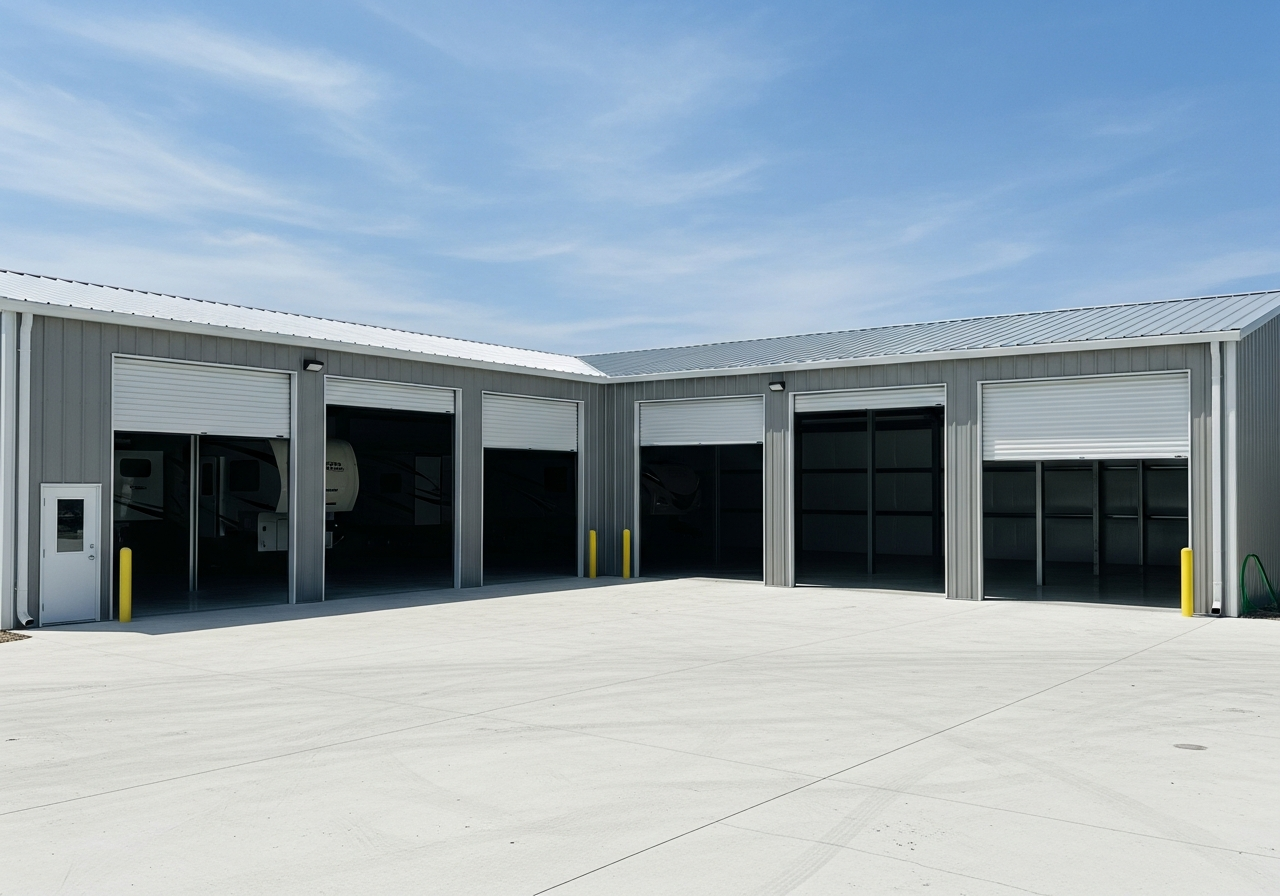
You're building or expanding paid RV and boat storage on a commercial or agricultural property. Multi-bay steel structures are the standard choice — durable, low-maintenance, and adaptable to covered or enclosed configurations depending on your market.
- Multi-bay pull-through configurations
- Covered storage (open-sided structures)
- Fully enclosed with climate options
- Wide circulation aisles for large vehicles
- Scalable — add bays in phases
How Much Space Do You Need?
Use this planner to size your RV or boat storage building. Results are dimensional planning guidance — not guaranteed engineering specifications.
Select your vehicle type above to see dimensional planning guidance.
Key Sizing Decisions
- Door height — measure your vehicle before specifying
- Door width — wider is usually better for large vehicles
- Bay depth — vehicle length + maneuvering room
- Pull-through — add another door set at the opposite end
- Circulation — leave room to walk beside the vehicle
- Future vehicles — plan for what you might own next
Planning Commercial RV Storage
Multi-bay commercial storage is one of the most practical applications for clear-span steel buildings. If you're building or expanding a storage operation, here's what drives the planning.
Bay Count and Width
Each enclosed bay needs to be wide enough for the largest vehicle you expect to accommodate, plus side clearance for opening doors and walking alongside. Commercial operators often build 14–18 ft wide bays.
Covered vs. Enclosed
Covered storage (open-sided canopy structures) costs less and accommodates vehicles that don't need full enclosure. Fully enclosed provides more security and better weather protection, commanding higher storage rates in most markets.
Circulation and Access
Large vehicles need wide aisles. A Class A motorhome needs significant turning radius. Plan your site layout before finalizing building dimensions — the parking approach and turnaround area are as important as the building footprint.
Site Planning
Level sites are significantly easier and cheaper to develop than sloped ones. Site prep, grading, and concrete are all influenced by your site's topography and drainage. Evaluate site conditions early.
Phase Planning
Commercial storage can be built in phases — start with a foundational structure and add bays as your occupancy grows. Steel buildings are well-suited to staged construction when the original structure is designed for it.
Revenue Planning
We don't fabricate ROI projections or guarantee occupancy. Local market rates and demand are the only meaningful data points. Research comparable storage rates in your market before projecting revenue.
We do not promise investment returns or guarantee occupancy rates for commercial storage projects. Do your own local market research.
Live Planning Estimate
What does a 30×50 RV storage building cost?
Here's a live planning range for a popular enclosed RV storage size — built with the same engine that powers our full calculator. Adjust any detail to match your actual project.
Based on: 30 × 50 ft RV Storage, 16 ft eave
RV & Boat Storage FAQ
Ready to Design Your RV Storage Building?
Tell us your vehicle type, dimensions, and layout goals. Jake or Michele will size it correctly and get you an accurate quote.
Design My RV / Boat Storage Building
Include your vehicle type and dimensions in the notes — Jake or Michele will follow up the same business day.